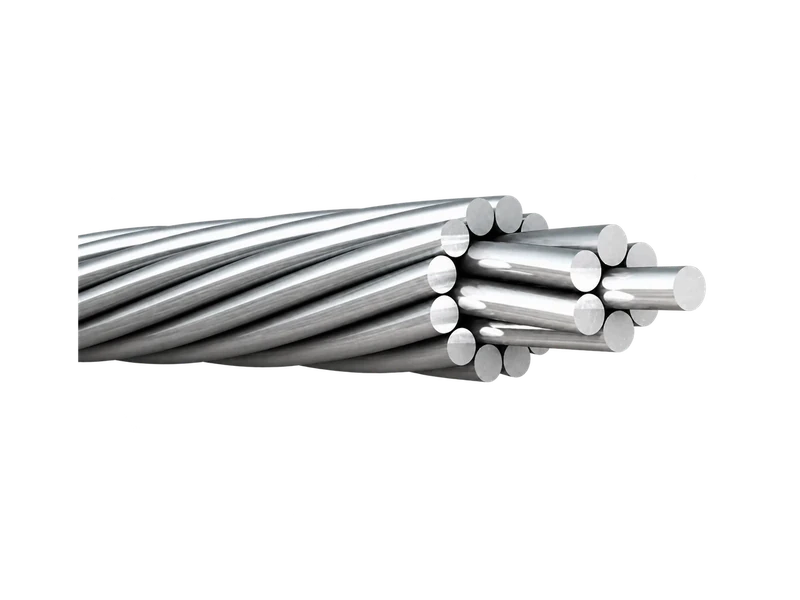
TAAAC Thermal-Resistant All-Aluminium Alloy Conductor
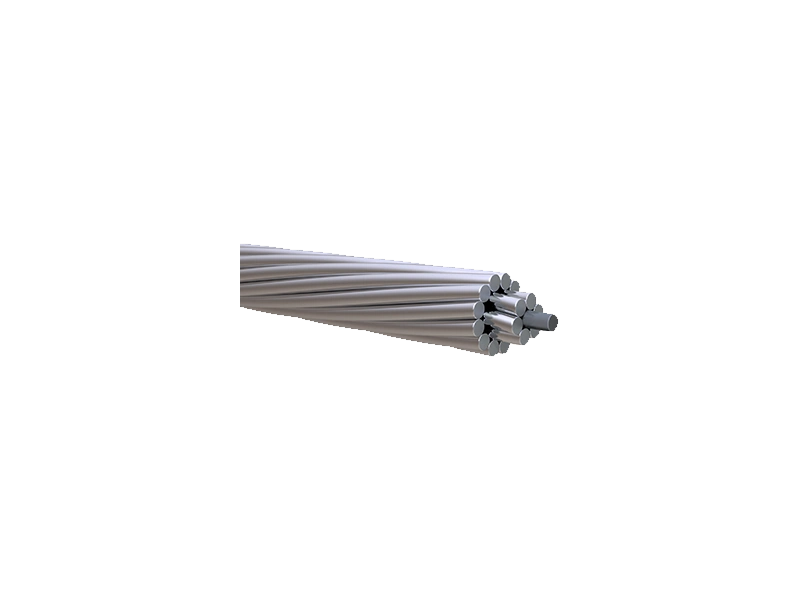
TAAAC conductor is built entirely from thermal-resistant aluminium-alloy wires and contains no steel or Invar reinforcing core. Its purpose is to provide an all-alloy current-carrying section for approved higher-temperature duty while retaining the mechanical logic of a homogeneous conductor. Span, tension and clearance limits must be checked from the exact construction.
Key Advantages
- All-alloy thermal construction: Every strand uses thermal-resistant aluminium alloy.
- No separate steel core: Mechanical strength comes from the alloy section itself.
- Clear material system: Suitable where an all-aluminium-based conductor is required.
Product Overview
TAAAC changes the wire material used in an all-alloy conductor rather than adding a separate high-strength core. The full cross-section contributes to both current transfer and mechanical behaviour. It is therefore structurally different from TACSR, STACIR and gap-type HTLS products, even when all are considered for higher-temperature service.
Because there is no steel-supported or low-expansion core, the project must verify that the alloy construction can meet tensile load, sag, creep, wind and ice duty as well as thermal requirements. Catalogue temperature statements must be used only with their stated conditions and an approved line rating and clearance study.
Key Features
- Homogeneous thermal-resistant aluminium-alloy strands form the complete conductor cross-section.
- Mechanical strength is provided by the alloy wires rather than a steel or Invar core.
- The all-alloy arrangement avoids a ferrous reinforcing core but still requires environmental and hardware assessment.
- Thermal capability, strength, resistance and sag must be taken from the exact approved construction and operating assumptions.
Product Applications
- Overhead capacity upgrades where an all-alloy thermal conductor is technically suitable
- Substation, plant or network connections within verified span and loading limits
- Lines comparing TAAAC with reinforced thermal conductors for a defined corridor
Technical Specifications
TAAAC JEC 3406-95
| Nominal Cross section area | Structure [number x diameter of wire] | Calculation area cross cestion | Approx. Diameter of conductor | Min.breaking strength | DC Resistance of conductor at 20℃ | Approx Mass of conductor | Current Carrying capacity | |
|---|---|---|---|---|---|---|---|---|
| mm² | n | mm | mm² | mm | kN | Ω/km | Kg/km | A |
| 120 | 19 | 2.80 | 117.0 | 14.00 | 17.5 | 0.2493 | 320.1 | 566 |
| 150 | 19 | 3.15 | 148.1 | 15.75 | 22.2 | 0.1970 | 405.1 | 659 |
| 200 | 19 | 3.65 | 198.8 | 18.25 | 29.2 | 0.1467 | 543.9 | 798 |
| 240 | 19 | 4.00 | 238.8 | 20.00 | 34.2 | 0.1220 | 654.5 | 897 |
| 300 | 37 | 3.20 | 297.6 | 22.40 | 44.5 | 0.0986 | 816.0 | 1036 |
| 400 | 37 | 3.70 | 397.8 | 25.90 | 58.0 | 0.0737 | 1097.0 | 1258 |
| 510 | 37 | 4.20 | 512.6 | 29.40 | 73.3 | 0.0571 | 1413.0 | 1491 |
| 660 | 61 | 3.70 | 655.9 | 33.30 | 95.6 | 0.0448 | 1812.0 | 1753 |
| 850 | 61 | 4.20 | 845.1 | 37.80 | 120.9 | 0.0342 | 2334.0 | 2073 |
| 980 | 61 | 3.70 | 978.4 | 40.70 | 142.7 | 0.0302 | 2714.0 | 2272 |
| 1030 | 91 | 3.80 | 1032.1 | 41.80 | 150.5 | 0.0286 | 2864.0 | 2353 |
| 1260 | 91 | 4.20 | 1260.8 | 46.20 | 180.3 | 0.0234 | 3499.0 | 2672 |
| 1600 | 127 | 4.00 | 1595.9 | 52.00 | 228.5 | 0.0186 | 4440.0 | 3083 |
| 2020 | 127 | 4.50 | 2019.5 | 58.50 | 289.0 | 0.0147 | 5616.0 | 3540 |
| 2500 | 127 | 5.00 | 2493.7 | 65.00 | 357.0 | 0.0118 | 6937.0 | 3988 |
TAAAC JEC 197
| Cross Sectional area | Na/Dia of wire | Approximately | DC conduvtor Resistance at 20℃,max | Calcuated breaking load min | Current Carrying capacity | Standard Delivery lenght | ||
|---|---|---|---|---|---|---|---|---|
| Overall diameter | Net weight | |||||||
| mm² | Pcs/mm | mm | Kg/km | Ω/km | kgf | n | A | m |
| 150 | 19/3.20 | 16 | 419 | 0.1910 | 2270 | 22268 | 700 | 5000 |
| 200 | 19/3.70 | 18.5 | 560 | 0.1430 | 3030 | 29724 | 850 | 5000 |
| 240 | 19/4.00 | 20 | 655 | 0.1220 | 3490 | 34236 | 945 | 3000 |
| 300 | 37/3.20 | 22.4 | 821 | 0.0958 | 4430 | 43458 | 1090 | 3000 |
| 400 | 37/3.70 | 25.9 | 1097 | 0.0737 | 5890 | 57780 | 1325 | 2000 |
| 510 | 37/4.20 | 29.4 | 1414 | 0.0571 | 7460 | 73182 | 1565 | 2000 |
| 660 | 61/3.70 | 33.3 | 1812 | 0.0448 | 9720 | 95353 | 1840 | 1500 |
| 850 | 61/4.20 | 37.8 | 2335 | 0.0347 | 12300 | 120663 | 2175 | 1000 |
| 980 | 91/3.70 | 40.7 | 2716 | 0.0302 | 14500 | 142245 | 2380 | 1000 |
| 1030 | 91/3.80 | 41.8 | 2865 | 0.0286 | 15320 | 150289 | 2465 | 1000 |
| 1260 | 91/4.20 | 46.2 | 3501 | 0.0234 | 18350 | 180013 | 2800 | 500 |
Request the Complete Data Sheet
From Production to Delivery
From raw material preparation to final shipmen, every stage is caretuly controled to ensure consistent conductor quality, reliable pertormance,and sae delivery. Our roduction,
inspection, packaging, and logistics processes are managed in accordance with applicable standards and project requirements.
Production
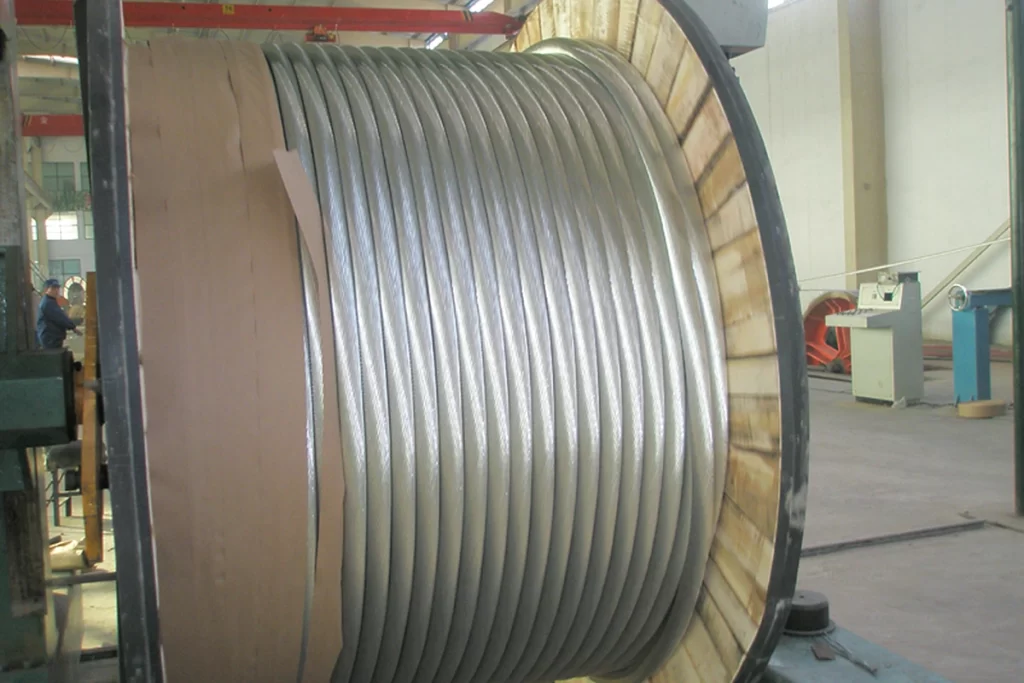
Thermal-resistant aluminium-alloy rod is drawn to the specified wire diameter and condition, then all wires are concentrically stranded without a separate core.
Inspection
Inspection verifies alloy-wire condition, strand count, wire diameter, finished area and diameter, minimum breaking strength and catalogue construction values.
Packaging
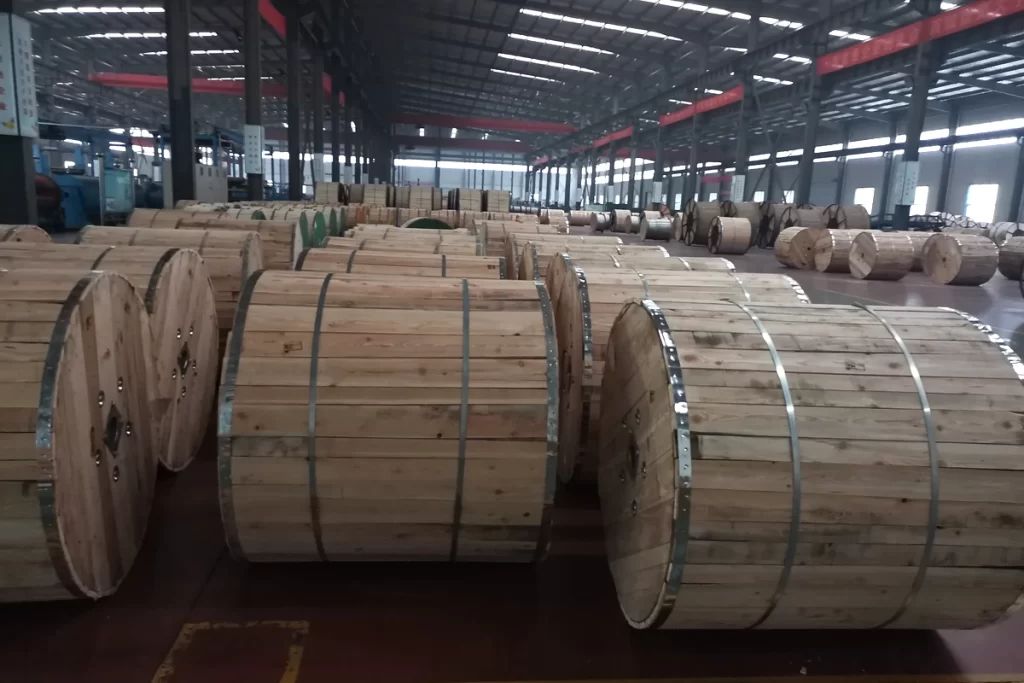
The all-alloy conductor is wound with controlled tension to avoid surface damage, strand distortion and local bending that could affect installation.
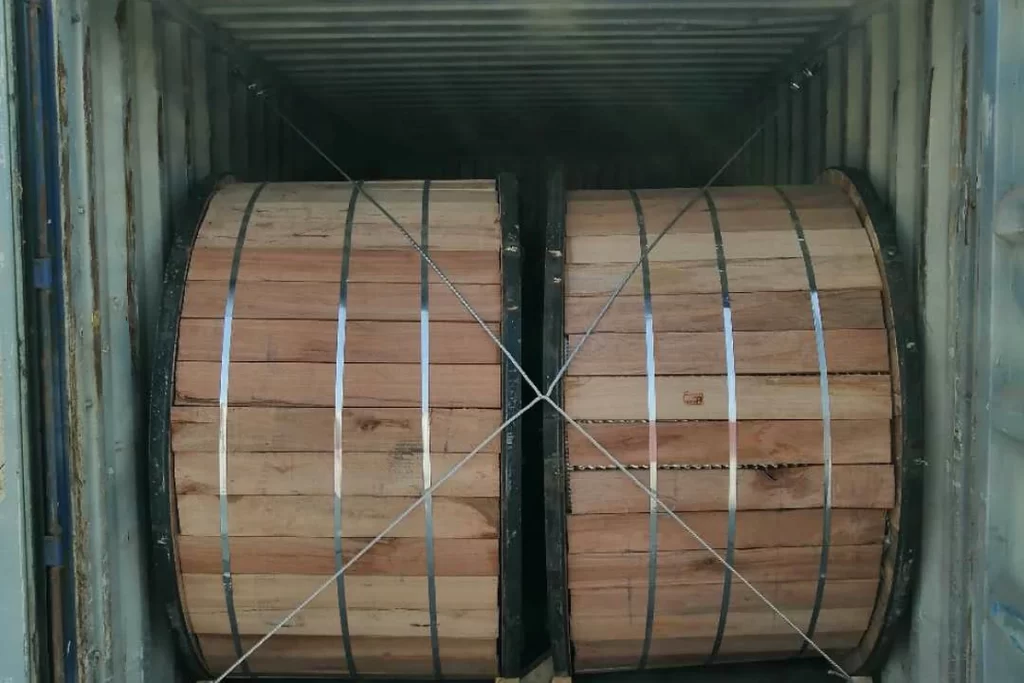
Shipping
Drum identification records TAAAC size, catalogue reference, ordered length and inspection documents before export shipment.
Frequently Asked Questions
Where does TAAAC obtain mechanical strength without a steel core?
Its thermal-resistant aluminium-alloy wires provide the conductor’s mechanical strength as well as the current-carrying area. The approved alloy, strand construction and total area determine the available rating.
How should TAAAC be compared with ordinary AAAC?
Compare the specified wire material, thermal qualification, strength, resistance, creep and allowable operating conditions. TAAAC is selected for thermal-resistant alloy behaviour, not merely because both products have no steel core.
Why is TAAAC not automatically a low-sag conductor?
It has no steel-supported, gap or low-expansion core to dominate high-temperature elongation. Sag performance must be calculated from the all-alloy conductor data, tension, spans, creep and temperature range.
Can TAAAC use standard AAAC fittings?
Only if the fitting supplier approves them for the exact TAAAC diameter, alloy, strength, operating temperature and strand design. Temperature and compression requirements may differ from ordinary AAAC.
What limits a TAAAC reconductoring project?
Key limits include tensile and structure loads, high-temperature sag and clearance, current rating assumptions, vibration, existing hardware, stringing tension, drum handling and outage conditions.
Which standard and temperature details belong in a TAAAC enquiry?
State the governing standard and edition, conductor construction, required normal and emergency conditions, rating assumptions, mechanical loads, tests, fittings, quantity and drum length.
Request for Free Consultation
Contact Information
Send us your cable requirements and our team will respond quickly with product recommendations, technical support and quotation details.