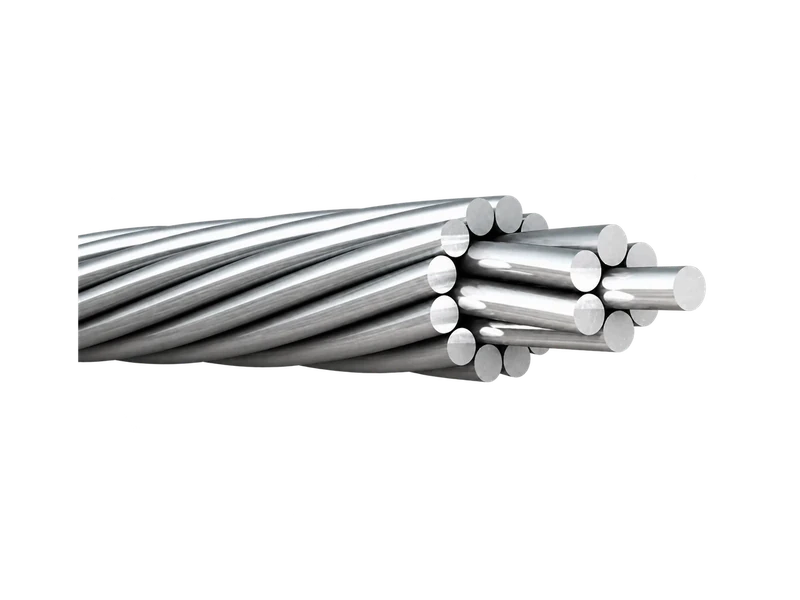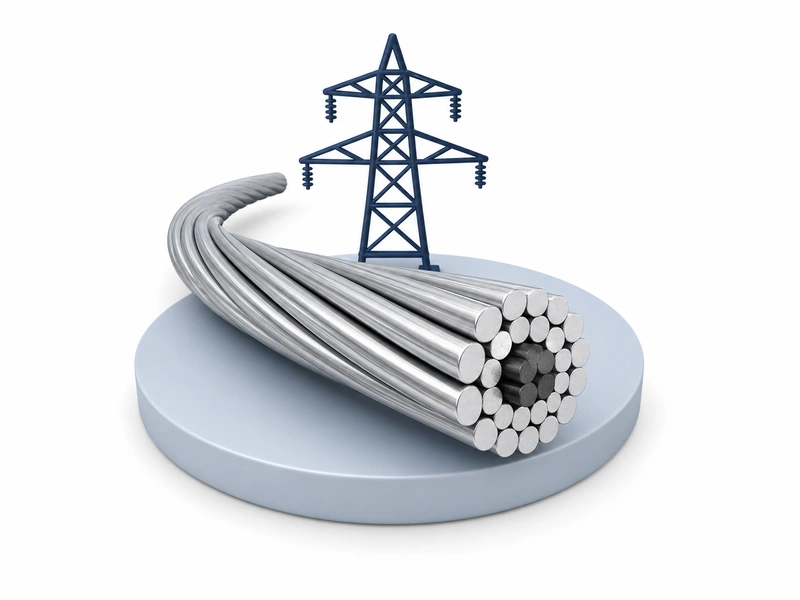
Choosing between AAC, AAAC and ACSR starts with the line’s electrical load, span lengths, mechanical loads and environment. AAC suits applications with modest strength requirements; AAAC adds alloy strength without a steel core; ACSR uses steel reinforcement for mechanically demanding routes. The final choice requires electrical and sag–tension calculations for the actual conductor design.
AAC vs AAAC vs ACSR at a Glance
| Selection factor | AAC | AAAC | ACSR |
| Material and structure | Stranded electrical-grade aluminum | Stranded aluminum alloy | Aluminum strands around a coated steel core |
| Strength | Lower strength than comparable AAAC | Higher strength-to-weight ratio than AAC | Strength depends on steel grade and core proportion |
| Electrical trade-off | High conductivity aluminum | Alloy strength comes with lower material conductivity | Steel occupies space and adds weight |
| Typical use | Shorter distribution spans with modest mechanical loads | Distribution and some transmission lines needing alloy strength | Transmission and distribution with demanding mechanical loads |
| Key consideration | Check tension and clearance limits | Check resistance and required cross-section | Specify core protection and compatible fittings |
These are selection tendencies, not interchangeable ratings. Compare candidates on a stated basis: equal diameter, equal resistance or equal cross-sectional area. Each basis can produce a different result.
What Each Conductor Is
AAC — All Aluminum Conductor
AAC commonly uses hard-drawn 1350-H19 aluminum wires throughout, with no separate reinforcing core. Its conductivity and low mass make it useful where electrical capacity matters more than high tensile strength. Shorter urban distribution spans are a typical example.
AAAC — All Aluminum Alloy Conductor
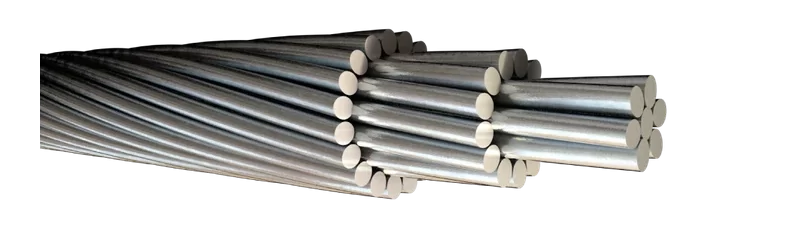
AAAC uses heat-treated aluminum-alloy wires, commonly 6201-T81 in ASTM designs. Strength comes from the alloy throughout the conductor. It can support greater mechanical demands than comparable AAC while avoiding a steel–aluminum interface.
ACSR — Aluminum Conductor Steel Reinforced
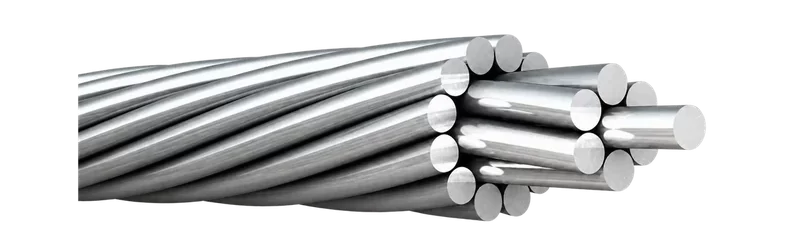
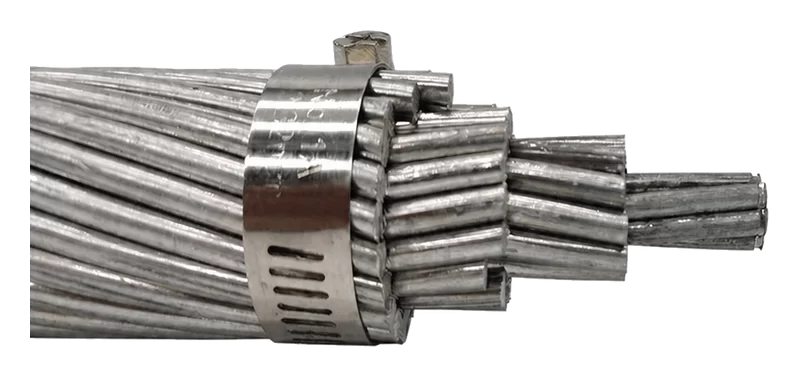
ACSR combines hard-drawn aluminum outer strands with a coated steel core. Aluminum provides most of the current-carrying capacity; steel increases mechanical strength. Core size, steel grade and coating are essential purchasing details.
How to Choose an Overhead Conductor
Match Electrical Performance to the Duty
Start with operating current, allowable voltage drop, fault duty and future demand. Ampacity means the current a conductor can carry under specified thermal conditions; it depends on conductor temperature, ambient temperature, wind and solar heating.
At equal metallic area and temperature, common 6201 AAAC has higher DC resistance than 1350 AAC. An AAAC option may therefore need a different cross-section to meet the same resistance target. ACSR does not automatically carry more current because it contains steel. Compare complete datasheets and thermal assumptions.
Check Strength, Weight and Sag Together
Rated tensile strength alone cannot establish an allowable span. Check conductor mass, installation tension, wind and ice loads, creep, support strength and required clearances. ACSR’s core enables mechanically demanding designs, but a higher steel proportion also adds mass.
Sag is the downward curve between supports. AAAC or ACSR may improve achievable span or clearance compared with AAC, but neither guarantees lower sag in every comparison. Require initial and final sag–tension calculations, including long-term creep and maximum operating temperature.
Assess Corrosion and Temperature Limits
AAC and AAAC have no steel core, removing the steel–aluminum interface as a corrosion mechanism. AAAC is often considered for coastal routes, but salt exposure, pollution, joints and maintenance still need assessment. For ACSR, specify core coating and any required grease rather than assuming all constructions offer identical protection.
Do not assign a universal operating temperature to AAC, AAAC or ACSR. The allowable limit depends on the material, exposure duration, strength retention, fittings and clearance design. Conventional ACSR is not equivalent to ACSS, which uses annealed aluminum and has different high-temperature design behavior.
Compare Installed Cost and Hardware
Request quotations for technically equivalent solutions. Include losses over the service life, support requirements, fittings, installation and maintenance. A lower conductor price per tonne does not establish a lower project cost. Clamps, joints and dead-ends must match the conductor’s material, diameter and construction.
Confirm the Standard and Exact Construction
Common ASTM product specifications include B231/B231M for AAC, B399/B399M for AAAC and B232/B232M for ACSR. Specify the contractually required edition and utility requirements. A standard reference alone does not identify conductor size, stranding, core protection or approved accessories.
What Buyers Should Include in an RFQ
Utilities, EPC contractors and distributors can reduce quotation revisions by providing:
Applicable standard, edition, utility specification and destination market.
Conductor designation, cross-sectional area, strand count, wire diameters and ACSR core details.
Required resistance, rated tensile strength, overall diameter and mass per unit length.
Line current, voltage, span profile, temperature assumptions, wind and ice conditions, and corrosion exposure.
Quantity, drum lengths, delivery terms, inspection requirements and compatible hardware.
Ask for a construction datasheet and the required inspection and test records, including dimensional, resistance and tensile checks. For ACSR, include core coating verification. Agree on acceptance criteria before ordering; a code word alone may not fully define the required construction.
Is AAAC better than AAC?
Frequently Asked Questions
AAAC generally offers greater strength than comparable AAC, but its alloy has lower conductivity than electrical-grade 1350 aluminum. Choose AAAC when its mechanical or environmental benefits justify the electrical and cost trade-offs. AAC remains appropriate when the design does not need additional strength.
Which conductor is suitable for long spans?
ACSR is commonly considered because its steel core supports higher mechanical loads. AAAC may also meet the requirement. Neither has a universal maximum span: the selected size, loading conditions, support capacity and sag–tension results determine suitability.
Is AAAC suitable for coastal environments?
AAAC is often considered because it avoids a steel core and offers favorable corrosion performance compared with conventional ACSR. It is not corrosion-proof. Confirm local exposure conditions, hardware compatibility and the utility’s approved material requirements.
Can AAAC replace ACSR on an existing line?
Sometimes, after engineering checks. Equal nominal size does not guarantee equal resistance, ampacity, strength or sag. Review clearances, support loads, fittings and protection requirements before approving a replacement.
Request a Conductor Quotation
Share your project specification, required quantity, destination and delivery schedule to request an AAC, AAAC or ACSR quotation. Include the approved construction and test requirements so offers can be compared on the same technical basis.